

How to Release Music as an Independent Artist
Every independent musician eventually faces the same question: how should I release my music?
It sounds simple. But the answer has never been more complicated — or more important to get right. The format you choose determines how much you earn, how your fans experience your music, how much it costs you upfront, and how much creative control you retain. Get it right, and releasing music can be one of the most rewarding things you do as an artist. Get it wrong, and you can spend months of effort and real money for returns that barely cover your streaming subscription.
In this post, we break down every major music release format available to independent artists today — digital streaming platforms, vinyl records, CDs, and the emerging phygital alternative, LEMN DROPS — and compare them honestly across the falemctors that actually matter.
The Four Main Ways to Release Music as an Independent Artist
Before we dig into the comparison, here’s a quick summary of what we’re actually comparing:
Digital Streaming Platforms — Releasing through a distributor (like DistroKid, TuneCore, or CD Baby) to get your music on Spotify, Apple Music, Amazon Music, and similar platforms. The dominant format today by listener numbers.
Vinyl Records — Pressing physical records and selling them direct-to-fan, at gigs, through Bandcamp, or through record stores. Requires significant upfront investment and lead time, but is experiencing a genuine commercial resurgence.
CDs — Manufacturing CDs for sale at concerts and online. Lower production cost than vinyl, faster to produce, and still a viable revenue stream particularly at live shows — and showing signs of comeback.
LEMN DROPS — A new phygital format that combines NFC-enabled physical collectibles with direct digital music access. Designed specifically to bring the ownership and revenue of physical media together with the convenience of digital, without a streaming platform taking a cut.
The Comparison: What Actually Matters to Independent Artists
There are eight factors that matter most when deciding how to release music as an independent artist. Here is how each format stacks up across all of them.
1. Revenue Per Sale or Stream
This is the number that independent musicians need to face head-on.
Streaming platforms pay between $0.003 and $0.005 per stream. To earn $1,000 from streams alone, your music needs to be played roughly 250,000 times. For the vast majority of independent artists, that volume simply doesn’t happen with any regularity. An artist with 10,000 dedicated fans — a genuinely significant following for an indie musician — might earn $30–$50 a month from streaming.
Vinyl and CDs tell a completely different story. A CD manufactured for $1.50–$2.50 per unit can be sold at a gig for $10–$15, giving the artist an 80%+ profit margin on each sale. Vinyl manufactured for $8–$12 per unit can be sold directly for $20–$35, yielding margins of 50–60%. When a fan buys physical media directly from an artist, the economics are immediately and dramatically better.
LEMN DROPS physical music distribution with NFC technology operates on the same direct-sale principle — artists pay around $3 or less per NFC music card unit including platform hosting fees and sell the album collectibles directly to fans at a price they determine, meaning every purchase generates meaningful revenue rather than fractions of a cent.
2. Upfront Production Cost
This is where digital streaming wins decisively for artists starting out.
Getting music onto streaming platforms through a distributor costs as little as $14–$25 per year for unlimited releases, or a one-time fee of around $10 per single through services like CD Baby. The barrier to entry is essentially zero.
CD production is significantly more affordable than most artists expect. A run of 100 CDs typically costs $150–$250 — roughly $1.50 to $2.50 per unit — making it accessible even on a tight budget.
Vinyl is where costs escalate seriously. A short run of 100–300 records typically costs between $1,200 and $3,000 upfront, depending on quality, color variants, packaging, and mastering. Most pressing plants also require a minimum order of 100 units, and lead times are currently running between 4 and 6 months at many facilities — a real constraint when planning a release.
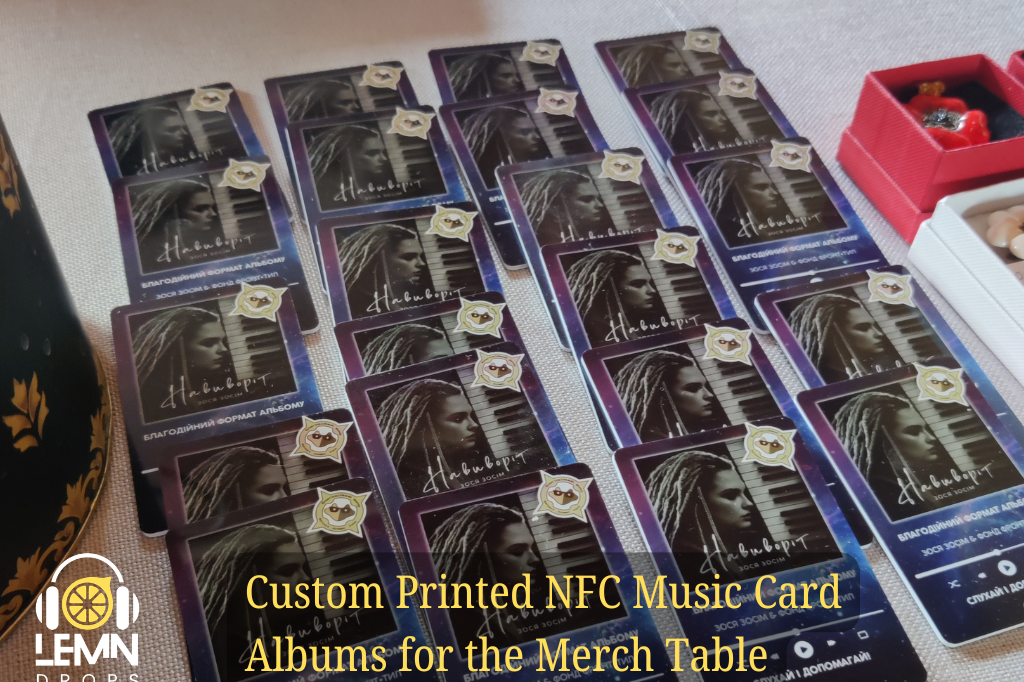
LEMN DROPS offers the NFC music cards for artists with custom printed artwork at a cost comparable to CDs at around $3-$3.50 for small volumes with a minimum order quantity of 50 cards. Unlike CDs or vinyl, a separate player or hardware is not required, the digital platform costs are covered in the purchase of the cards, no pressing plant queues, and no bulk inventory to fund before you can start selling.
3. Fan Connection and Perceived Value
Ask any independent artist who has sold physical records at a gig, and they’ll tell you: nothing creates a connection like a fan holding something physical.
Streaming is frictionless and anonymous. There is no moment of exchange, no object, no relationship. It is excellent for discovery, but it produces almost no sense of fan investment or loyalty in isolation.
Physical media — particularly vinyl — creates a ritual. The artwork, the sleeve, the act of playing it. Fans understand instinctively that buying a physical record from an artist directly supports that artist in a way streaming cannot match. There is weight to it, literally and figuratively.
CDs, while less romanticised than vinyl, still carry tangible value — particularly when signed by the artist, or as part of a limited run. At a merch table, they remain one of the most effective direct-to-fan revenue tools available.
LEMN DROPS is designed to preserve everything that makes physical media meaningful — the object, the intentional purchase, support, the ownership, the collector’s connection — while removing the hardware dependency. A fan can hold their LEMN DROP, collect them like vinyl or CD collectors and use it to access music anywhere, on any device with a simple tap of a smartphone.
4. Accessibility for the Listener
Streaming platforms are the most accessible music format ever created. Any song, anywhere, on any device, instantly. The listener experience is effectively frictionless — for the listener.
Vinyl, while beloved, requires hardware that is not universally owned. Not every fan has a turntable. Portability is non-existent. It is a beautiful format for the committed listener at home, but it excludes a significant portion of potential buyers.
CDs face a different accessibility problem. The format is universally understood, but CD drives have disappeared from most laptops and many cars. Playback hardware is increasingly something fans have to seek out rather than already own.
LEMN DROPS requires nothing more than a smartphone and an NFC reader — which is built into every modern iPhone and Android device. Tap the collectible and the music plays. No app download, no subscription, no hardware investment.
5. Artist Control and Rights
Independent artists should not underestimate this dimension. How you release your music determines whether you retain full ownership of your work.
Digital distributors do not take your rights — you retain full ownership of your masters when releasing through DistroKid, TuneCore, CD Baby, and similar services. However, streaming platforms themselves decide how your music is surfaced, promoted, and discovered. The algorithm is not yours to control.
Vinyl and CD releases are fully artist-controlled. You decide the artwork, the packaging, the price, the channels through which it’s sold. There is no intermediary platform between you and your fan.
LEMN DROPS follows the same direct-to-fan, artist-controlled model. The artist sets the price, owns the relationship with the fan, and retains complete creative control.
6. Scalability and Global Reach
This is where streaming genuinely excels and physical media reaches its limits.
A song released on streaming platforms is globally accessible the moment it goes live. A fan in Tokyo, São Paulo, or Berlin can find and listen to your music without you doing anything beyond the initial upload. For discovery and reach, no format comes close.
Vinyl and CDs are physical objects that need to be shipped. Selling globally from your own website or Bandcamp is possible, but shipping costs and logistics create real friction, particularly for heavier items like vinyl.
LEMN DROPS, as a smaller physical collectible in the form of an un-clonable NFC card music album that unlocks digital access, is far more practical to ship globally than vinyl, while still delivering the ownership and fan-connection benefits of physical media.
7. Longevity and Permanence
One under-appreciated risk of streaming for independent artists is that your music’s availability is contingent on a platform’s continued existence and your distributor’s annual fees. If you stop paying, your music may be removed. Streaming platforms have changed their terms, payout structures, and policies repeatedly.
A well-pressed vinyl record can last 50 years or more. A CD, stored correctly, is effectively permanent. Physical formats do not have subscription dependencies.
LEMN DROPS is built around ownership — once a fan has a LEMN DROP, the access it provides is theirs. Much like original vinyls, since they are created in limited runs, the rarer they are, the more collectible value they can have.
8. Discovery Potential
Streaming platforms have powerful discovery algorithms that can, in the right circumstances, introduce your music to listeners who have never heard of you. Playlist inclusion, radio features, and algorithmic recommendations are real opportunities — albeit highly competitive ones.
Physical media has essentially no passive discovery mechanism. People who buy your vinyl or CD already know about you.
LEMN DROPS, as an emerging format, is not primarily a discovery tool. It is a fan ownership and artist revenue tool — best understood as the format your most engaged fans choose after they’ve found you through streaming or live performance.
Comparison Table
| Streaming | Vinyl | CD | LEMN DROPS | |
|---|---|---|---|---|
| Revenue per unit/stream | $0.003–$0.005 per stream | $10–$20+ per record (direct) | $7–$12+ per CD (direct) | Direct sale — artist sets price |
| Upfront cost | $14–$25/yr (distributor) | $1,200–$3,000 for 100–300 units | $150–$250 for 100 units | Around $299-$330 for 50 units |
| Fan connection | Low | Very High | High | Very High |
| Listener accessibility | Very High | Low (needs turntable) | Medium (needs CD drive) | Very High (NFC smartphone) |
| Artist rights/control | Moderate (platform dependency) | Full | Full | Full |
| Global reach | Very High | Low–Medium (shipping limits) | Medium | High |
| Portability | Very High | Very Low | Low | High |
| Collectible/object value | None | Very High | Medium | Very High |
| Minimum order required | None | 100+ units typically | 50–100 units typically | 50 units typically |
| Lead time to release | Days | 4–6+ months | 2–4 weeks | 2-3 weeks |
| Longevity | Platform-dependent | 50+ years | Decades | Ownership-based |
| Discovery potential | High | Very Low | Very Low | Low |
| Best for | Discovery & reach | Superfans & collectors | Live sales & merch | Fans, collectors, live sales & merch |
So What’s the Best Way to Release Music as an Independent Artist?
The honest answer is: it depends on where you are in your journey — but here is a practical framework.
If you are just starting out, streaming should be your first step. The cost is minimal, the reach is global, and it gives potential fans a way to find you. There is a reason many smaller independent artists are disenchanted with this model as the percentage of earnings paid out to them is miniscule and often not viable. This is the same view that the digital streaming model is broken which has created a resurgence in demand for physical music media in recent times.
Once you have a fanbase — even a small, local one — physical media starts making financial sense. CDs are the most accessible entry point. A run of 100 CDs for a few hundred dollars, sold at shows for $10–$15 each, can fund your next recording session in an evening.
Vinyl makes sense when your fanbase is ready for it, and when you can absorb the upfront cost and production timeline. It is not the right first physical format for most independent artists, but it is an extraordinarily powerful one when the timing is right.
LEMN DROPS fills a gap that no existing format addresses well: the space between the fan who has moved beyond casual streaming but isn’t ready or able to commit to vinyl. A collectible they can own, that gives them direct music access, is similar to merch purchases that supports the artist directly, and that doesn’t require a turntable or a CD drive. It is the format designed for how music fans actually live now.